Resonance Medicine As A Bridge
Between Evidence And Experience
Part 1: Resonance as a Regulative Principle
Summary
How can we explain resonance phenomena, how do they work, and what promotes them? In which areas does resonance have an effect? This article explores these questions and develops a comprehensive and multidimensional resonance model using heart health as an example. Especially in medicine, where objectively verifiable knowledge (disease) intersects with the body’s subjective experience of crisis (being ill), resonance gains particular relevance as a regulatory principle. Resonance is understood here as a regulatory principle of living systems that integrates biological, psychological, social, and cultural dimensions and can be therapeutically effective. This integrative model bridges the gap between evidence-based medicine and subjective experience. Resonance medicine could become a new paradigm that integrates discipline-specific perspectives and, moreover, facilitates interdisciplinary dialogue.
Keywords: Resonance, Resonance medicine, regulatory principle, heart health, biological resonance field
The heart is not only a biological organ, but also an eco-sensitive resonance center. Applied resonance medicine can effectively contribute to heart health
Many people know these special, almost magical moments in the consultation or at the bedside, in which an atmosphere of trust and coherence is built. Suddenly, mutual understanding and a tangible agreement set in. In such situations, time seems to stretch a bit and run slower. It is such “moments of consciousness” in which “the spark jumps” that, in my experience, have often led to change processes on the way to recovery and healing. These precious moments are difficult to describe in words. We also encounter them in other contexts of life, for example in exchanges with friends, when experiencing nature or when we deal with music or art. In this context, I refer to these phenomena as an experience of resonance
Resonance Medicine
Since the 1990s, the concept of evidence-based medicine (EBM) has increasingly dominated medicine. RCTs (randomised controlled trials) are the gold standard in this respect: they check the efficacy and safety of therapeutic measures. Meta-analyses of RCTs form the basis of guideline medicine. Parallel to this development, the need to consider psychological and social aspects of the disease in treatment is also becoming apparent. The biopsychosocial model according to Engels has been recognized since the 1970s. In medicine and health science, however, there is a growing interest in integrative and systemic approaches that go beyond this approach [28]. In particular, it was suggested that the spiritual and environmental dimension of health should be taken into account [51]. The concept of resonance is attracting increasing interest, among other things as a complementary model to EBM, and there has even been talk of “resonance-based medicine” [20]. Resonance – understood as the resonance of biological, psychological, social and cultural systems – can go back to the alienation of today’s human being in the medical context. While some so-called “resonance medicine” procedures rely on speculative energetic concepts, there are a large number of resonance phenomena in empirical and humanities research that are measurable, reproducible and therapeutically relevant. The aim of this article is to present a resonance medicine model in a multidimensional perspective in 4 fields, which resonance can capture in different ways.
Resonance As a Regulative Principle
Resonance is derived from the Latin verb resonare, which means “to resonate” or “to echo”. Originally, the word referred to the physical level of resonance (e.g. of a musical instrument). In psychology, resonance has been describing empathic resonance for over 50 years [73]. Since the 1990s, this phenomenon has been neurobiologically supported by the discovery of mirror neurons [7][8][14][38]. The sociologist Hartmut Rosa introduced resonance into the life-worldly connection [74] as a concept that could lead postmodern man out of his alienation [35]. In recent years, there has been a tendency to expand the concept of resonance and use it as an overarching principle in other disciplines.
Using the example of heart health, this present article develops a scientifically sound resonance model based on established concepts of medicine, neurobiology and physiology, systems biology, psychology, body phenomenology, meditation research, sociology and cultural studies. Based on 4 clusters, resonance is understood as a regulative principle of living systems. The scientific-analytical fuzziness of the resonance fields is an expression of a conscious conceptual decision: it serves to open up the research space and to integrate the heart as a multifunctional resonance organ in a bio-psychosocial and cultural dimension. The dimensions of being human are classified in a methodological pluralistic and polypragmatic manner in the sense of Thomas S. Kuhns [45]. The argumentation is predominantly empirically proven and in many places integrated into phenomenological and hermeneutical models. Hahn’s Circle of Methods [30] is used as a methodological epistemological metamodel, which represents a further development of Viktor von Weizsäcker‘s Gestalt Circle.
Resonance is not understood in the narrow physical sense as a mere transmission of vibrations, but rather as a fundamentally bodily based response behavior of living systems to their environment and social world.
Resonance is not understood here in the narrow physical sense as a mere transmission of vibrations, but rather as a fundamentally bodily based response behavior of living systems to their environment and social world. It may refer to:
- Ability of a system to react adaptively and regulatively to appropriate impulses [49][52]: Resonance here implies a processual structural coupling of autopoetic systems, which is made possible by autonomous self-regulation (e.g., Polyvagal Theory of Porges [65][66], neurovisceral integration of Thayer and Lane [92][93]).
- Form of dynamic coherence formation between internal and external processes, mediated by the autonomic nervous system and specific neuronal networks: From the point of view of neurovisceral integration [92][93], psychophysiological coherence arises through vagal regulation. Mirror neurons and brain social networks enable emotional resonance with others [7][8][14][26][38][46][95]. Default Mode Network and Insula are involved in inner self-coherence, body awareness and empathy. Embodiment and interoception theories show that body sensations are the basis for emotions, self-perception and action control [13][82][97]. The insula, anterior cingulate cortex (ACC) and somatosensory areas process signals from the heart, breathing and intestines. Conscious interoception improves both self-regulation and resilience and reduces stress responses.
In addition, resonance can be broadened as:
- relational principle that concerns not only neuronal or biological processes, but also has psychological, social, cultural and ecological connections [7][8][74][78][80]: resonance here creates intercorporeality and cosmopolitanism [24][25] by transcending the boundaries of the individual organism.
- Condition of successful development and health: Living systems not only survive in resonance relationships, but also grow, learn and form their identity [7][8][85][86].
- Bodily phenomenological basic mode of being-in-the-world, which is anchored both pre-linguistically-affectively and symbolically-cognitively: resonance thus combines physiological regulation with existential [learning-as-]meaning-making [25][55][79].
- State of meaningful connectedness, which is subjectively experienced as physically perceptible coherence [25][74]: Resonance is thus more than mere homeostasis – it is an existential basic relationship of living beings to the world, in which coherence is experienced as meaningfulness, connectedness and liveliness.
From a bodily phenomenological perspective, resonance is therefore not merely a functional or systemic phenomenon, but rather an atmospheric perceptive relationship to the world. The living body – also called the “body” (not as a purely biomechanical object, but rather as “embodied subjectivity” [25][55]) – is the medium in which resonance is experienced before all cognitive reflection: as affective resonance, as atmospheric density, as coherence, or even as strangeness and resistance.
In the sense of Hartmut Rosa’s theory of resonance [74], resonance is an existential basic relationship between the subject and the world, which is characterized by mutual touchability, responsiveness, and transformation. Rosa describes resonance as “emotion” and “adaptation” of the world, as a mode of successful relationship to the world that increasingly slips away from late modern man because he is not available as a matter of course. Structural alienation – for example through acceleration, functionalization and instrumental rationalization – prevents resonance by causing world relations to tip over into muteness or sensory overload. Thinking in terms of resonance theory therefore also means looking for forms and spaces in which the world can once again be experienced as capable of responding.
Especially in medicine, in which objectifying knowledge (disease) is superimposed with subjective experiences of crisis of the body (being ill), resonance as a regulative principle gains particular relevance. Resonance medicine in the broader sense would not only treat pathophysiological conditions, but also promote the physical and mental ability to respond to the world – for example, through mindful attention, atmospheric design of healing spaces, promotion of self-efficacy and relationship quality.
Resonance Field
I define a resonance field as a relational space in which adaptive and regulating interactions between living systems take place. Internal and external processes interact both materially and immaterially, enabling the whole complex spectrum of reciprocal relationships in and between resonance fields.
Important features of the resonance field are:
- Relationship orientation: A resonance field is not an isolated object, but rather a network of mutual connections between at least 2 “vibration carriers” (e.g. heart-heart, heart-brain, heart-sound, heart-medicine, human-nature, symbol-consciousness).
- Vibrational character: These connections have a material or immaterial structure that manifests itself in recurring patterns.
- Resonance ability: Not every impact creates resonance. Only when there is a “fit” (e.g. physical-biological in the form of characteristics, frequency and rhythm or psychosocially in mood or meaning) can reinforcement or synchronization engage.
- Multidimensionality: The resonance fields mentioned can be biological, psychological, social and cultural. This includes, among other things, artistic, spiritual or ecological dimensions.
- Dynamics and transformation: In the resonance field, not only amplifications or attenuations arise, but also new qualities. Meanings, impulses for action or structures can change.
Resonance medicine of the heart according to this expanded understanding is thus based on an integrative interplay of empirically ascertainable and subjectively experiential phenomena: from imaging findings, laboratory analyses, ECG diagnostics, heart rate variability measurement to emotional mirroring, semantic fit and attribution of meaning, bodily sensations and interbodily communication to ecological integration. Resonance becomes the counter-model of a “disembodied” mechanized medicine and a possible way out of the feeling of alienation that many patients experience in their relationship with modern health care.
Basic attitudes in resonance medicine
- Understanding the practice as a “resonance space” in which opportunities for healing open up
- Genuine curiosity, empathy, openness and a clear attitude promote resonance. Remain self-critical: “I could also be wrong. It could also be completely different.” [30]
- Work in networks (e.g. interdisciplinary, integrative).
Figure 2: Resonance in nature: Fireflies synchronize pulsating light signals into a silent field of mutual perception and connectedness. The photo not included in this translated edition.
The 4 Fields of the Resonance Model
Resonance shows itself as a processual multidimensional coherence that interlocks in different levels of the living organism and has a mutually regulating effect. The interactions have a cyclical character. Resonance thus arises from individual cyclical processes in which the levels interact with each other.
In the context of the 4-field resonance model, a resonance field refers to a relational sphere of action in which a system (e.g. the human organism, the heart or a social group) vibrates reciprocally with its social environment, so that rhythms, processes, patterns of meaning or qualities are amplified, synchronized or transformed (Fig. 2). By the way, if there is no resonance, one can speak of “dissonance” or “decoherence”.
Each resonance field is embedded in a specific level and is determined by its characteristics:
- Biological (e.g. cardiac rhythms, biomechanical heart function, physiological coupling with other organ systems, chronobiology, nutrition, exercise, regulation through integrative medicine)
- Psychological (e.g. affect regulation, empathy)
- Social (e.g. social inclusion, lifestyle)
- Cultural (e.g. meaning and sense as language and sign resonances, artistic expression, cultural affiliation, spiritual dimensions)
- Transversal (e.g. informational-systemic correlates in constellations, meditation, “presencing” of Theory U)
4 + 1 Model of Resonance Medicine
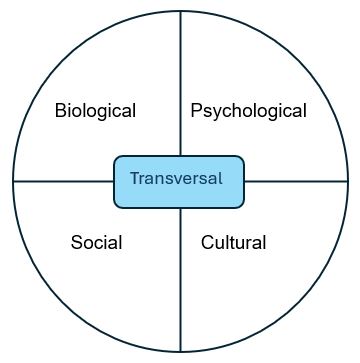 Figure 3: The 4+1 model of resonance medicine. The transverse level is a connecting deep layer that underlies the other fields. [Diagram © Dr. Moyzes]
Fields 2-4(+1) are executed in Part 2, which appears in Issue 2/26 of zkm.
The entire resonance field acts as a dynamic mediation space in which the respective levels can be intertwined. Resonance occurs when there is a fit between internal vibrational patterns of the system and external impulses, so that mutual amplification or transformation on one or more levels is possible.
From the point of view of heart health, the resonance field can be felt physically – e.g. as palpitation, pulsation, pain, tension, breathing rate and rhythm, inner balance or derailment. Central to this is the experience of bodily coherence in the oscillation of tension and relaxation, narrowness and expansiveness, closeness and distance, activity and rest. In a bodily phenomenological sense, the heart functions as a resonance center that moderates the transitions in the process.
Biological Field
Organic-Systemic Resonance
Organic-systemic resonance refers to the finely tuned, rhythmic-synergetic interaction of central organ systems – especially the heart, lungs, kidneys, liver and endocrine system – mediated via autonomous, humoral and mechanical feedback loops. Heart-breathing coherence (e.g. visible in the HRV pattern) is considered the central resonance phenomenon of this level [2][29][54][64][83]. These rhythmic couplings are made therapeutically accessible by conventional physiological measures such as medication (e.g. sartans, ACE inhibitors, beta-blockers, statins) as well as non-invasive (e.g. CPAP mask for sleep apnea syndrome) or invasive interventions (e.g. stent implantation, ablations) as well as by complementary medical procedures.
Neurophysiological Resonance
The autonomic nervous system forms a central switching point for resonant reactions: the sympathetic and parasympathetic nervous systems oscillate in dynamic counterweight regulation. HRV-biofeedback, vagus stimulation, breathing techniques, and somatosensory procedures (e.g., Feldenkrais, craniosacral therapy, osteopathy) use this plasticity to promote adaptive resonance. Mirror neuron networks and affect regulation in the limbic system also locate resonant response behavior to interbodily stimuli [2][7][8][26][29][38][46][54][64][83][95].
Biochemical Resonance
Macronutrients and micronutrients do not act in isolation, but rather unfold their effects in dynamic resonance processes within the cellular metabolism. Mitochondrial health [59][84], the reduction of insidious chronic inflammation (silent inflammation) and redox systems earn an important role in this. Microbiological resonance – for example in the gut-brain-microbiome complex – also influences neuroimmunological and psychovegetative control circuits, which in turn can modulate affects, sleep quality and cognitive clarity [15][18][43][53][67][81]. Healthy nutrition, micronutrients, probiotics and phytotherapeutics (e.g. AGE = aged garlic extract) do not intervene here in the sense of classic pharmacomechanical interventions, but rather promote fine regulatory impulses in the biological milieu. In the context of heart health, such complementary measures, accompanying established cardiological therapies, can support metabolic homeostasis, mitigate side effects and strengthen the regulatory ability of the entire organism.
Chronobiological Resonance
The circadian rhythm is a central clock system of life. Light, temperature, sleep-wake cycles, meal times, exercise routines, and social rhythms act as “timers” that resonate with internal oscillators (e.g., suprachiasmatic nucleus). Cardiovascular heart health is directly influenced by circadian rhythms [27][70][94]. Light regulation, sleep hygiene, melatonin cycles or fasting periods unfold their effect via the resynchronization of biological clocks [34][56][72].
In an expanded understanding, the heart is not only in nature, but also integrated with nature in planetary rhythms, climatic conditions and ecological relationships.
Nature-Related Resonance
The nature-related level describes the resonant relationship between humans and nature, in which the heart appears not only as a biological organ, but also as an eco-sensitive resonance center. This resonance unfolds through forms of closeness to nature (biophilia), sensual perception of the environment as well as emotional attachment to natural habitats. Numerous studies have proven the heart-protective effect of contact with nature, for example by lowering blood pressure, cortisol levels and heart rate variability [3][31][36][48][68][90][96]. Experiencing nature calms the default mode network, inhibits the sympathetic nervous system and activates parasympathetic regulation – physiological processes that can be experienced bodily as silence, inner expansiveness, centering or connected presence. These experiences can be both contemplative (e.g. through forest bathing or landscape meditation) and active (e.g. through gardening or contact with animals). In an expanded understanding, the heart is equally in nature as well as with nature – integrated into planetary rhythms, climatic conditions and ecological relationships. Extreme climatic events, heat waves and air pollution have been proven to have serious effects on heart health, especially in vulnerable population groups such as the elderly or cardiovascular diseases. The heart not only reacts to psychological or social stimuli, but is also a biologically sensitive barometer of ecological crises. Resonance in the ecological sense therefore also means responsibility – an ethical attitude of care towards the world around us, in which human well-being is not understood in isolation, but rather as part of a living network of relationships. Here, the heart functions as a symbol of planetary connectedness, of an ecological ethic that extends the protection of life, mindfulness and compassion to both people and the entire biosphere.
Application
In addition to classical medication and invasive procedures, therapeutic applications of such a multidimensional understanding of resonance range from sports therapy, HRV-biofeedback, interval hypoxia training (IHT), respiratory therapy, fasting rhythms, nutrient therapy, adaptogenic phytotherapy, microbiome modulation and up to nature therapy, forest bathing (Japanese: shinrin-yoku) or mindfulness in nature and environmental experiences. The decisive factor is not the isolated intervention, but rather the quality of resonance in the overall milieu, i.e. the degree of physical responsiveness and coherence ability that is promoted by the respective measure.
Diagnostics
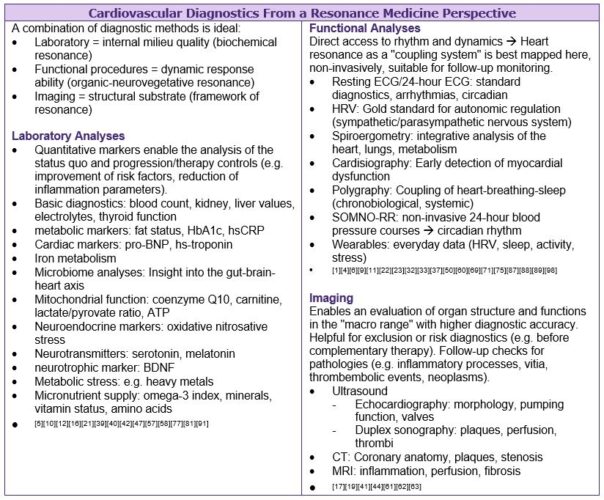
How can heart health be studied from a resonance medicine perspective? Medical research in recent decades has provided us with many diagnostic possibilities. A selection of central and well-validated diagnostic methods is shown in the box below. The list does not claim to be complete, it is rather intended to provide an orientation as to which methods can make a contribution at which level.
Outlook
How can resonance medicine be implemented therapeutically in concrete terms? How is resonance described on a psychological, social, cultural and transversal level?
Part 2 of this article (to be published in zkm 2/26) will explain these levels of the resonance model and give recommendations suitable for everyday use. In summary, resonance medicine understands recovery not as a linear process, but as the restoration of coherence through resonance – physically tangible, neurobiologically anchored, culturally embedded, ecologically connected and existentially significant.
Conflict of interest: The author states that there is no conflict of interest.

An Exclusive Translated Article for P2P Supporters
From the Monthly Publications of P2P
Published January 2026
From an article in zkm – Zeitschrift für Komplementärmedizin, Volume 17, Issue 6 2025
Translation & redaction by: Carolyn L. Winsor, P2P Consulting
© Copyright 2025, zkm, Moyzes, Germany
AI Digital and online translation assistance utilized.

Literature
For zkm subscribers the literature can be found at: http://dx.doi.org/10.1055/a-2733-7500